-min.png "UWM_Spread (1)-min")
 By Cat Halliwell
Organisations are rethinking how work gets done, moving beyond the limits of traditional recruitment to embrace agile, predictive talent strategies that unlock new opportunities.
For decades, traditional recruitment has served as the backbone of organisational growth. Yet the landscape is evolving. The Predictive Talent model, for instance, integrates predictive analytics and AI into talent acquisition to help forecast needs, identify the best candidates and make data-driven hiring decisions. Whilst this model provides enhanced agility, efficiency and a stronger alignment with future needs, achieving meaningful transformation is seldom straightforward or consistent across the board.
With that in mind, here is a practical, step-by-step framework for bringing the Predictive Talent model to life, highlighting the importance of its coexistence with established recruitment practices. As business leaders and HR teams, we have a unique opportunity: to drive sustainable change by operationalising this model alongside established practices to drive transformation whilst minimising disruption.

Defining Talent in the Age of AI
Today’s leaders must look beyond traditional definitions of talent. The modern workforce represents a fusion of human and digital capabilities, forming a truly blended workforce. This isn’t just about people or technology in isolation; it’s about how they interact and work together.
Generative and agentic AI bring new dimensions to this mix, combining:
- Pure human capabilities
- Human capabilities enhanced by technology
- Purely digital capabilities, such as AI agents
Optimising talent is no longer just about filling roles; it’s about perfecting collaboration across this entire spectrum to unlock productivity at scale.
What is Predictive Talent?
Predictive Talent puts future success at the heart of an organisation’s talent strategy — focusing on how work gets done and the opportunities it creates for people. Success isn’t achieved simply by assigning people to positions; rather, it requires anticipating what success looks like and intentionally building towards it.
This approach includes digital worker strategies that optimise technology, whether through automation or by augmenting human work. Think of it as a model that blends people and technology seamlessly, often leveraging tools such as success profiles to guide decisions and ensure alignment with future business needs.
Traditional Recruitment + Predictive Talent: The Case for Coexistence
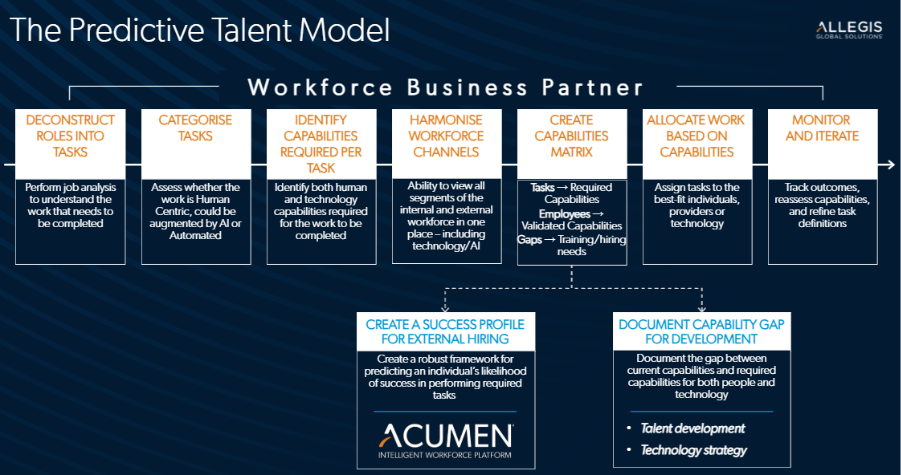
Transformation doesn’t happen overnight, and it rarely moves at the same pace across every part of the business. By allowing traditional recruitment and Predictive Talent strategies to operate side by side, organisations gain the flexibility to evolve at their own speed while building advocacy through real-world success.
The traditional model of matching job specifications to CVs and hiring based on experience, offers reliability and comfort, especially where stability matters. But it can be restrictive and reactive, often missing opportunities for greater productivity and future readiness.
Predictive Talent flips the conversation from “Who do we want to hire?” to “What needs to be achieved?” and “What does success look like?” It breaks roles into tasks, defines success profiles and applies a harmonised approach to sourcing talent across every channel: permanent, contingent, internal or external. The result? A more agile, nuanced workforce strategy that blends human and AI capabilities for optimal outcomes.
Coexistence is key. Running both models in parallel minimises disruption, supports organic adoption and gives HR and talent acquisition the opportunity to gather evidence, build advocacy and showcase the benefits of Predictive Talent through real-world wins — laying the foundation for broader transformation. A dual-path approach gives leaders the flexibility to choose what works best for their context. Traditional recruitment when it fits, or Predictive Talent when agility and future-readiness matter most.
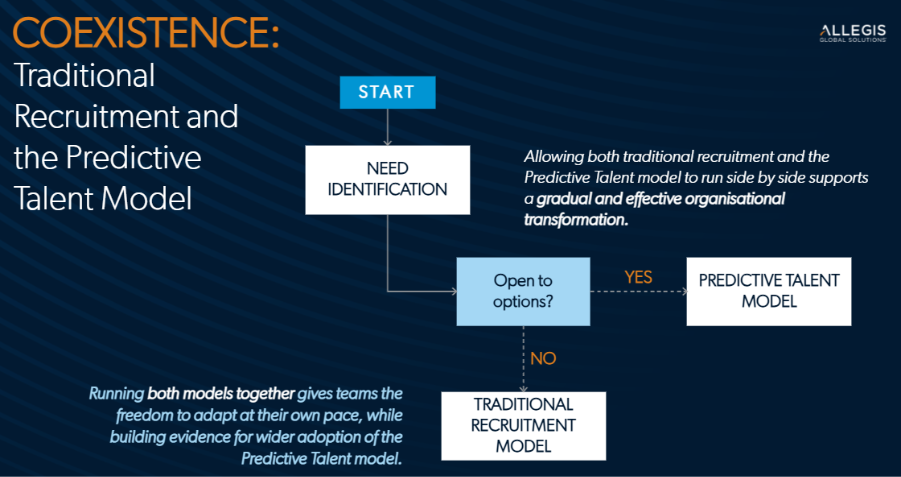
Step-by-Step Operationalisation Framework for the Predictive Talent Model
Below you’ll find a clear, actionable framework—broken into seven practical steps—to help you operationalise the Predictive Talent model and translate concept into impact across your organisation.
1. Deconstruct Roles into Tasks
The journey to Predictive Talent starts by breaking roles down into individual tasks. It is also important to note that not all tasks are created equal. These can vary in complexity, duration, frequency and importance, so understanding them is critical to understanding the work demand.
Deconstructing roles means going beyond the job description. It’s essentially a deep-dive job analysis that delves beneath the surface of a job description to uncover every component activity, not just the headline responsibilities to create a more precise and comprehensive picture of what’s needed to get work done.
By detailing every task, you can also spot duplication, redundancies, and opportunities for operational improvement. Our Acumen® Intelligent Workforce Platform has agentic AI capabilities to accelerate role deconstruction across thousands of job titles.
2. Categorise Tasks by Execution Mode
Once you’ve identified the tasks, the next step is to decide how each should be executed. This is where you determine the potential for AI to automate, augment or assist, and pinpoint which skills are most valuable for each category.
For every task, you should consider how much human skill, judgement and values are required? How much of the task is driven by data, patterns or rules?
Answering these questions will then help you categorise the tasks into:
- Human Centric - tasks that are most appropriate for humans due to the complexity of human interaction, emotional intelligence, moral reasoning or complex decision making. These tasks involve high levels of creativity, empathy, ethics or judgment, which are essential for the task outcome and cannot be easily replaced or replicated by AI.
- AI-Augmented - tasks that can benefit from AI to improve or supplement human capabilities, creating more productivity or knowledge without completely eliminating the human involvement. These tasks involve moderate levels of data, patterns or recommendations, which can support human performance and decision making.
- Automation - tasks that AI can completely automate, where human involvement is low or not necessary, improving processes and lowering the demand for human involvement in repetitive or predictable tasks. These tasks involve low levels of variation, complexity or creativity, which can be easily performed or optimised by AI.
3. Identify Skills Required Per Task
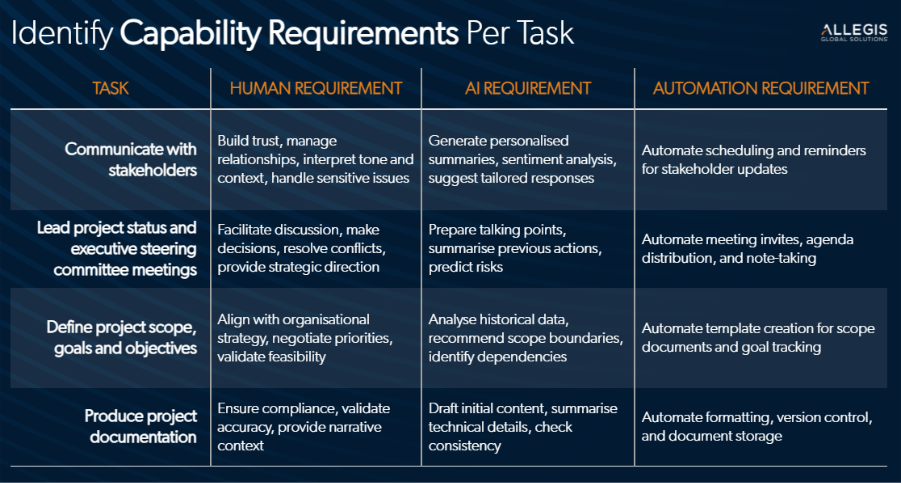
Once you’ve mapped out the tasks, the next step is to get specific about the capabilities needed for success. This means moving beyond generic job descriptions and drawing on skills taxonomies, performance data and insights from subject matter experts to clarify exactly what’s required, whether that’s human skills, AI support or automation.
For each task, we break down the human requirements – such as building trust, managing relationships, or providing strategic direction – alongside the potential for AI to add value, for example by generating personalised summaries or predicting risks. We also identify what can be automated, such as scheduling or document formatting.
Validating these requirements through interviews, surveys and benchmarking against best practices ensures the skill map is both relevant and complete. This level of rigour is essential for identifying skill gaps, guiding training and informing hiring decisions.
Identifying and categorising tasks reveals where skill sets may need to evolve; for example, AI-augmented tasks demand greater digital literacy. Once required capabilities are pinpointed, we set proficiency levels based on the task’s complexity, frequency and role expectations — so a customer service representative might need only basic data analysis skills, while a data scientist requires expert proficiency.
By clarifying proficiency levels, we ensure hiring, training and development are aligned to the actual needs of the work and not arbitrary standards. This avoids over- or under-hiring, reduces inefficiency and supports workforce satisfaction. Ultimately, this approach gives us a clear, actionable view of what’s needed for every task — enabling us to allocate work more effectively, upskill our teams where it matters and make the most of both human and digital capabilities.
4. Harmonise Workforce Channels
Harmonising workforce channels brings together all sources of talent – internal employees, contractors, gig workers, service providers and now technology and AI – under a single, skills-based framework. Instead of defaulting to familiar hiring routes or operating in silos, this approach gives leaders real-time visibility across the entire talent ecosystem — enabling smarter, faster and more objective decisions. Work is allocated based on capability and business need, not just legacy processes. Applying a consistent skills taxonomy ensures fair and objective evaluation, supporting internal mobility and inclusive allocation decisions.
By integrating technology and AI as workforce channels alongside human talent, harmonisation empowers hiring managers to select the best-fit solution for every challenge; whether that’s an internal move, a contingent worker, an external partner or an AI-driven tool. This flexibility drives agility, supports fair evaluation and positions the business to respond dynamically as demands evolve. Ultimately, it’s about building a workforce strategy that is inclusive, efficient and ready for the future.
Workforce business partners act as strategic advisors, interpreting skills data and guiding allocation decisions. Digital platforms, such as Acumen, provide real-time visibility into available capabilities, enabling on-demand matching and streamlined onboarding. Regular communication, robust governance and ongoing feedback ensure the approach remains relevant and effective as business needs evolve.
5. Create a Capabilities Matrix
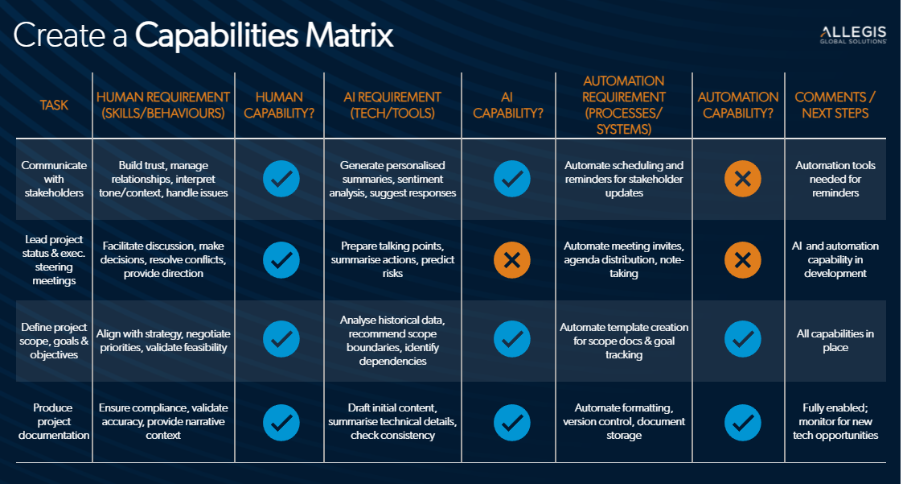
A digital, searchable capability matrix forms the backbone of effective workforce planning. For instance, consider the task: "communicate with stakeholders." On the human side, this involves building trust and managing relationships. AI supports this process by providing sentiment analysis and generating tailored responses, while automation streamlines scheduling and reminders. This process is repeated for every key task, capturing not only what is required, but also whether those capabilities are present, where gaps exist and what actions are necessary.
A well-constructed digital matrix provides a real-time, evidence-based view of workforce capability, highlighting strengths and pinpointing opportunities for training, technology investment or automation to boost efficiency. This enables leaders to allocate work based on actual capability — driving agility, operational efficiency and better business outcomes. The goal is to empower leaders to make smart, dynamic decisions and ensure the organisation is ready for future challenges, fully leveraging both human and digital capabilities.
6. Allocate Work Based on Capabilities
With the matrix in place, work is allocated to the best-fit individuals, teams or technology — drawing from internal talent, the wider external pool and AI tools. Internal mobility is prioritised to support career growth and retention. Meanwhile, external options such as contractors or gig workers provide flexibility for short-term or specialist needs. Where appropriate, automation and/or AI is integrated to free up human capacity for higher-value work.
Crucially, insights from the matrix directly inform both talent development and technology strategy, highlighting where to focus investment on upskilling, reskilling or hiring, and where to deploy or enhance digital solutions. This approach goes beyond simply filling roles; it ensures the right capability is matched to the right work, every time, keeping the organisation agile, future-ready and able to respond confidently to evolving demands.
7. Monitor and Iterate
Continuous improvement is essential. Track outcomes, reassess skills and refine task definitions through a structured feedback loop. Monitoring should address both immediate results and long-term metrics, such as productivity, satisfaction, retention and strategic goal attainment.
Insights from this process inform succession planning, targeted development and strategic workforce decisions — embedding adaptability and foresight into organisational culture.
Incorporating Success Profiles for External Talent Acquisition
If, after reviewing your capability matrix, you find that the required skills or expertise are not available within your current workforce, it becomes necessary to look externally to fill those gaps. To ensure each new hire truly meets your organisational needs, a structured success profile is crucial for predicting candidate fit and future performance. The Four-Box Success Profile offers a transparent, evidence-based approach that goes beyond relying on intuition or simply ticking off qualifications. It assesses candidates across four critical dimensions:
- Skills: Technical and functional abilities, validated through objective assessments
- Behaviours in Scenarios: How candidates respond in real or hypothetical situations, evaluated through scenario- or competency-based interview questions relevant to the role
- Background: Experiences and education that contextualise readiness and depth
- Values Alignment: Compatibility with organisational culture, mission and ways of working
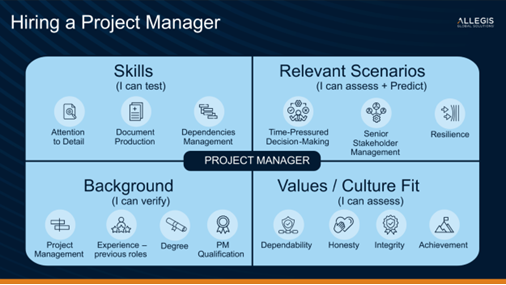
The weighting of each dimension is adjusted by role type. For entry-level positions, skills and values alignment may carry the most weight, while for specialist or senior roles, background and proven experience become more significant. This flexible approach ensures the right fit for both immediate needs and long-term objectives.
By using the Four-Box Success Profile, hiring decisions become balanced, transparent and repeatable —driving performance, engagement and sustainable success. It’s about making sure every hire is not just capable but truly aligned with what the organisation needs now and in the future.
Transformation as a Journey
The recognition that traditional recruitment methods and the Predictive Talent model can operate side by side reflects that workforce transformation is an ongoing process rather than a single event. By honouring the gradual nature of change, equipping leaders to make considered decisions and cultivating support through proven outcomes, organisations can balance stability with progress. The structured operationalisation steps described here offer a clear, practical route towards building a workforce that is more adaptable, resilient and prepared to meet future demands, ensuring readiness for the challenges and opportunities ahead.



 By Julie Jenkins
 By Rob Marley
 By JoAnne Estrada