By Renee Gorman
The semiconductor industry is entering one of its most consequential expansion cycles in decades. Governments and private-sector leaders are committing billions of dollars to new fabrication capacity, advanced packaging, AI infrastructure and more resilient supply chains. Yet the industry’s ability to convert that investment into productive capacity will depend on a resource that cannot be built quickly: skilled talent.
Deloitte estimates that the global semiconductor industry will need more than one million additional skilled workers by 2030. In the US alone, the Semiconductor Industry Association projects workforce demand will grow by approximately 115,000 positions by 2030, with roughly 67,000 of those roles at risk of going unfilled. These figures point to a structural challenge, not a short-term recruiting cycle. Semiconductor companies are expanding at the same time experienced workers are retiring, emerging technologies are changing skill requirements and adjacent industries are competing for many of the same engineers, technicians and digital specialists. It’s likely that the impending bottleneck won’t be due to access to capital or equipment but rather the ability to find, develop and deploy the skills required to turn investment into output.

Five Forces Reshaping Semiconductor Workforce Demand
As the semiconductor industry expands, talent challenges are becoming more complex, specialized and tied to location. The following five forces show why workforce planning must become more dynamic, data-driven and closely connected to business strategy.
1. The AI Boom is Creating New Workforce Pressure
AI is increasing demand for chips along with the specialists who design, manufacture, package and optimize them. Semiconductor architects, AI hardware engineers, high-performance computing specialists, advanced packaging engineers, data scientists and design automation experts are increasingly central to product road maps. At the same time, many of these workers are also being recruited by AI software companies, cloud providers and advanced manufacturers. Semiconductor companies are no longer competing only with one another for talent. They are competing with organizations that may offer different career paths, locations, compensation models and working environments. This competition for talent is expected to grow as semiconductor industry revenue continues to climb toward $1 trillion by 2030.
Workforce implication: Traditional peer-group benchmarking is no longer enough. Companies need visibility into cross-industry skill demand, compensation pressure, talent movement and the capabilities most likely to become scarce.
2. Advanced Packaging is Becoming a Critical Capability
For decades, semiconductor performance gains were closely associated with shrinking transistor sizes. While transistor scaling remains important, innovation is increasingly being driven by advances in packaging, memory, connectivity and chip architecture. Technologies such as chiplets, 3D packaging and high-bandwidth memory have become important differentiators, particularly for AI and high-performance computing.
As innovation expands beyond the silicon itself, so does the range of expertise required. Employers need packaging engineers, thermal design specialists, signal integrity engineers and manufacturing experts who can work across design, materials, process and production environments. IEEE has highlighted how next-generation packaging is creating new skill requirements as semiconductor architectures become more integrated and complex.
Workforce implication: Many organizations have mature sourcing strategies for chip design talent, but fewer have a clear view of the advanced packaging talent market. Identifying adjacent skills, transferable experience and alternative talent locations will be critical as demand grows faster than established pipelines.
3. Supplier Ecosystems are Becoming More Specialized
Foundries, packaging providers, equipment manufacturers and materials suppliers each play distinct roles, while emerging technologies, such as chiplets, are increasing dependence across the ecosystem.
As a result, organizations need talent that can work across company boundaries, coordinate complex supply chains, manage quality and risk and translate requirements from one stage of production to the next.
Workforce implication: Semiconductor expertise alone is not sufficient. Program management, supplier collaboration, quality systems, advanced manufacturing operations and ecosystem governance are becoming more valuable. Workforce plans must account for how work is distributed, not just how many people are needed.
4. The Skills Gap Spans the Entire Talent Chain
The semiconductor talent shortage extends well beyond highly specialized engineers. Demand is growing across technical, manufacturing and operations roles, including technicians, software professionals and engineering talent with expertise in areas such as materials, process and automation. The Semiconductor Industry Association has identified potential workforce gaps across technicians, computer scientists and engineers, highlighting the breadth of the challenge.
Demographics add another layer of complexity. As experienced workers retire, organizations risk losing valuable institutional knowledge alongside workforce capacity. Building the next generation of talent will require a combination of education partnerships, apprenticeships, internal mobility, reskilling and deliberate knowledge transfer.
Workforce implication: There is no single solution to the semiconductor talent shortage. Companies need different strategies for different types of talent, realistic expectations for how long it takes new hires to get up to speed and a clear understanding of which roles could create operational challenges if experienced workers leave.
5. Geography Matters More Than Ever
Semiconductor talent remains highly concentrated. Established ecosystems in Taiwan, South Korea, Singapore, the US, the Netherlands and Germany benefit from deep networks of employers, universities, suppliers and experienced workers. Meanwhile, investment is expanding in emerging or fast-growing hubs across India, Vietnam and Malaysia, as well as in the US, including Arizona, Texas, New York and Ohio.
Capital investment can move faster than labor markets. A location may offer incentives, infrastructure and available land while still lacking the volume or mix of skills needed to support construction, launch, ramp-up and sustained operations. Competition may also intensify when several major employers enter the same market within a short time period.
Workforce implication: Site selection and workforce planning can no longer be separate exercises. Leaders need location-level insights into talent supply, graduation pipelines, employer competition, compensation, worker mobility and the time required to build new capabilities. The question is not simply, “Where can we build?” It is, “Where can we find, develop and retain the skills required to run what we build?”

From Job Titles to Capabilities
Job titles can obscure emerging skills, transferable capabilities and meaningful differences between roles that appear similar on paper. Semiconductor leaders need a more detailed view of the capabilities behind the work.
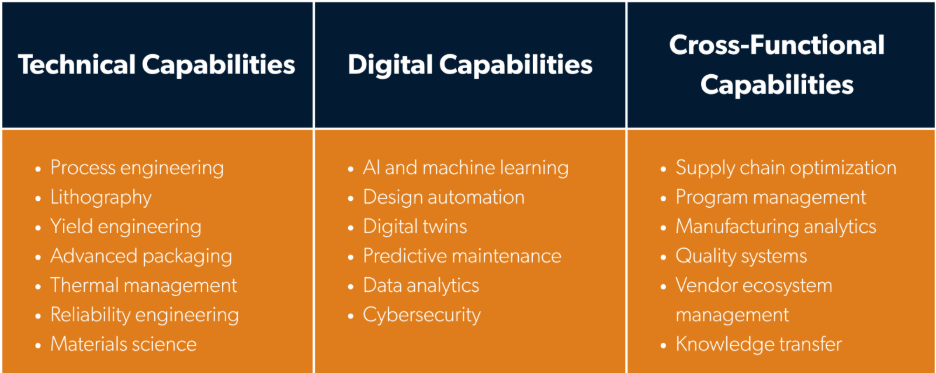
A capability-based view reveals where skills already exist, where adjacent talent can be developed and where organizations will need to look elsewhere. That intelligence can then inform decisions about location, compensation, suppliers and workforce risk.
Workforce Strategy Should Impact Investment Decisions
Traditional workforce planning has typically centered on headcount, job families, experience levels, education requirements and locations. Those factors still matter, but they don't answer some critical questions: Are the required skills available? Is demand growing faster than expected? Will competition for talent make hiring difficult? Forward-looking semiconductor workforce planning requires a more dynamic set of inputs:
- Current and projected skill availability
- Skill demand and time to fill
- Competitor demand and market concentration
- Emerging and adjacent capabilities
- Compensation and rate trends
- Education and training pipelines
- Workforce mobility and location attractiveness
- Build, buy, borrow and partner options
Semiconductor companies can no longer assume talent will be available wherever they invest. Workforce strategy must be built into decisions about capital investments, site selection, operating models and production ramps — not treated as an afterthought.
How AGS Helps Semiconductor Leaders Make Confident, Data-Backed Decisions
AGS helps semiconductor leaders turn workforce intelligence into action by helping them:
- Translate market signals into workforce decisions. Understand shifts in talent availability, skills and demand to inform hiring, workforce mix and timing.
- See supply and demand more clearly. Connect market intelligence with program and supplier performance to identify sourcing gaps, rate issues and alternative talent pools.
- Strengthen location and investment planning. Evaluate talent availability, competition, compensation and pipeline strength before making expansion decisions.
- Modernize skills and rate strategies. Look beyond job titles to understand critical capabilities, define roles and align rates with the market.
- Spot emerging risks earlier. Monitor talent supply, demand, rates, turnover, supplier performance and emerging skill requirements before they affect delivery.
The objective is not more data. It is a clearer line of sight from market conditions to business action, so semiconductor leaders can make confident decisions about where to invest, how to access talent and which workforce risks require intervention.
The Competitive Advantage Behind the Technology
Leading semiconductor organizations are already expanding university and technical-school partnerships, building technician pipelines, investing in reskilling, broadening hiring criteria, using global talent ecosystems and applying labor market intelligence to workforce planning. The strongest strategies don’t rely on a single intervention. They connect long-term pipeline development with near-term access to skills and continuous market visibility. For decades, semiconductor competitiveness has been measured through process nodes, manufacturing yields, production capacity and speed of innovation. Workforce readiness now belongs in that equation.
The next semiconductor bottleneck may not be silicon. It may be talent, and the organizations with the strongest market intelligence will be best positioned to respond.



 By Renee Gorman

 By Amy Walker