-min.png "UWM_Spread (1)-min")
 By Renee Gorman
The American tech job market is in the midst of a seismic transformation, and AI is at the epicenter. If you’re watching the headlines, you know AI is no longer just a buzzword — it’s an economic engine driving unprecedented change in how companies recruit, the skills they value and where talent is most in demand. Our latest white paper explores these shifts, offering fresh data and perspective on what’s happening now and what’s next.
To illuminate these trends, Allegis Global Solutions conducted a comprehensive analysis of approximately 30,000 AI and computer science job assignments sourced from our proprietary Acumen® Intelligent Workforce Platform. This data covers US job assignments for our managed service provider (MSP) clients from January 2023 to May 2025, providing a detailed look at how demand for AI talent is evolving and where opportunities are emerging most rapidly.

1. Rising Demand for AI Roles Amid a Shifting IT Workforce
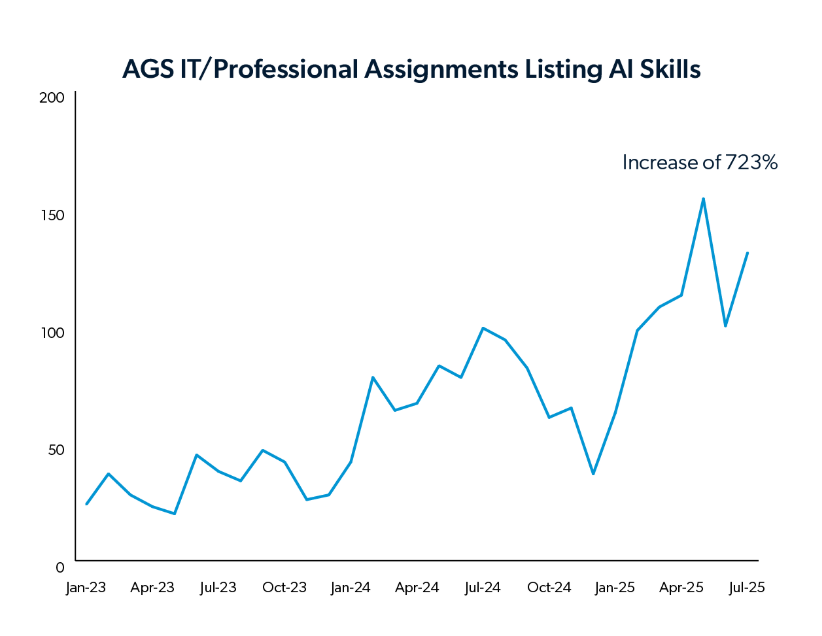
While overall IT job postings have declined since 2022, AI-related positions continue to demonstrate strong growth. Postings for data scientists are up 34%, and machine learning engineer assignments have soared an incredible 700% since 2023. And it’s not just a short-term spike — assignments requiring AI skills have jumped 723% since 2023, echoing other research showing a 640% increase in AI talent demand over the past eight years.
Yet, despite these impressive growth figures, AI roles still represent a small section of the overall IT job market. Most organizations are selectively adopting AI for targeted initiatives, hiring specialized talent and proceeding with operational caution as they experiment with these technologies.
2. Early-Career Tech Roles Are Shrinking in the Age of AI
One of the most surprising – and concerning – findings in our white paper is the shrinking pipeline of entry-level opportunities for IT professionals. Advanced AI tools are automating routine tasks, reducing the need for large teams of junior developers and engineers. In fact, data reveals a notable decline in employment for early-career workers in the most AI-exposed fields, even as more experienced professionals see stable or growing opportunities.
Companies are increasingly seeking mid-level and senior talent to manage and ethically deploy AI. However, the long-term risk is clear: without investing in new talent now, organizations may face a leadership vacuum down the road. Ironically, younger workers – who frequently demonstrate the greatest proficiency with AI – are most affected by these reductions.
3. Non-Tech Industries Are Increasing Demand for AI Skills
AI is rapidly crossing occupational boundaries, reshaping industries well beyond traditional tech. From healthcare and logistics to marketing and construction, AI skills are becoming essential across the board. Our analysis shows that while IT roles still account for 55% of AI-related assignments, a significant 45% are now in non-tech sectors. This broadening footprint signals that AI literacy is fast becoming a must-have, regardless of industry, and organizations that prioritize upskilling and reskilling will be in the best position to thrive.
4. The New Geography of AI Jobs: US Cities Leading Talent Growth
The race for AI talent is also redrawing America’s tech landscape. While Silicon Valley and Seattle have long been the epicenters, cities like Los Angeles, Dallas-Fort Worth, Boston, Chicago and Raleigh, North Carolina are rapidly gaining ground. Los Angeles overtook Seattle in AI job postings in 2025, and Raleigh saw a 600% jump in postings since 2023. This democratization of opportunity means job seekers have more options than ever, and employers can tap into new markets and fresh perspectives.
How Companies Can Build a Sustainable Workforce in an AI-Driven Future
Our white paper concludes that while AI is driving a strategic shift in hiring – favoring specialized skills and experienced talent – it also poses long-term risks by narrowing the pipeline of future leaders and innovators.
The expanding influence of AI across sectors and cities demands a renewed focus on adaptability, upskilling and strategic workforce planning. The challenge for organizations is not just to keep pace with technological innovation, but to ensure their workforce evolves alongside it, fostering resilience, creativity and sustainable progress.
Curious to dive deeper? Our full white paper examines these trends with exclusive data and actionable insights, helping employers and job seekers prepare for the next chapter in tech hiring. Download the full report and get ready to rethink your IT workforce planning in the age of AI.


 By Renee Gorman
 By Amy Walker
 By Simon Bradberry